CAMACHA VILLAGE
My small village in Madeira Island has some interesting spots with forgotten stories of a distant past. I was born in a village called Camacha. It is one of the highest points in the Island where people live. Sometimes locals are called "mountain people". The presence of English families there is something that even today we can still have memory. It is common to read in some local studies about the reason why English people went there, mostly during the summer to spend some time in summer houses. The similarities with the weather in the United Kingdom and Camacha is always present as an argument. The presence of nature and big trees are also some of the reasons. It is believed that the first place where a football game, in Portugal, was played, was in Camacha, precisely because of the presence of English families. The first game was played in the year 1875. A flat and long field in the centre of the locality was convenient and adequate for the practice of one of the most famous sports of our time. (SILVA and AZEVEDO DE MENEZES 1921)

A football match in my hometown at the beginning of the 20th century.
Harry Hinton was an English student and its family has a big tradition on the island in some businesses. He is told as the first one bringing football to Portugal. Below there is a short text about it written in the hall of a famous hotel in Madeira.

I would, also, like to talk about two interesting stories about the past of my hometown. Both of them and including the subject of football are realities and alive memories that I believe it is important to preserve. Camacha village is a small place and forgetting the short story and heritage that is related with the place is the danger of becoming a place with no place in the world and Madeira History, something that is not true as long as Camacha has some very interesting spots to show and stories to be told. The objective of talking about these cases of history and heritage is related to my direction on my studies before going to Cardiff University and also one direction that I want to follow in my dissertation on my MA in Global Cultures in Cardiff. Questions of heritage preservation, memory, local cultures, dynamic preservation are some of the subjects that I want to explore and it is natural to put an eye of what my hometown possesses in relation with those questions.
Dr Michael Grabham, a Physician from England, and Ayres de Ornelas e Vasconcelos family are two relevant cases in the History of Camacha and in the History in general. These two cases had repercussions at international level as I will explain in more detail later in this text. Perhaps we can say that these two cases are related to an idea of famous personalities and families, which is true. Nevertheless, this not means that Camacha does not have its popular culture and rituals, and indeed it has, but my direction here is to write about some cases that are forgotten and most of the people, even in my hometown, don´t know.
Michael Grabham brought a big clock from Liverpool that was the first community clock in the town. He built a tower to set the clock and today it is a café and souvenir shop. It is, indeed, an important memory of the past which has been preserved and we can find today. He was, also, the man who brought the clock of Madeira's Cathedral. Today, most of the people relate this clock with a common clock and the name and the history of the man who brought it is absent.
Michael Grabham brought a big clock from Liverpool that was the first community clock in the town. He built a tower to set the clock and today it is a café and souvenir shop. It is, indeed, an important memory of the past which has been preserved and we can find today. He was, also, the man who brought the clock of Madeira's Cathedral. Today, most of the people relate this clock with a common clock and the name and the history of the man who brought it is absent.

The clock and the tower. A gift from Dr Michael Grabham to the community.
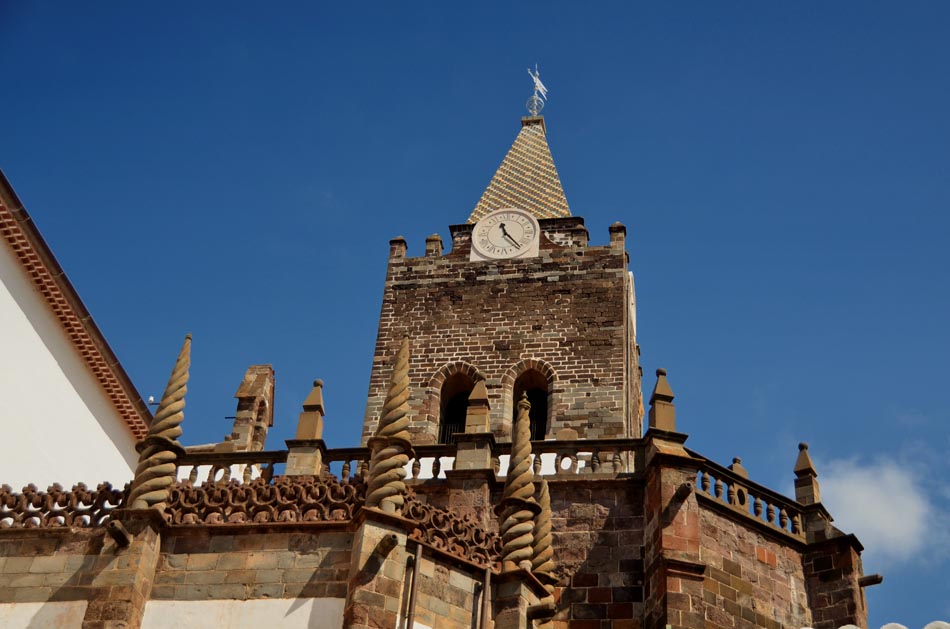
The clock in Madeira Island Cathedral, also a gift from Dr Michael Grabham
Dr Michael Grabham was also a writer and a businessman. He built the first Hotel in my hometown, today, unfortunately, in ruins. Some of his books are related to Madeira Island and the belief that the Island had therapeutic properties, mostly connected with lungs and respiratory diseases. He also wrote about nature (GRABHAM 1911) and other subjects.


Above, the first Hotel in my hometown's announcement in Dr Michael Grabham´s property. I found this in an old journal when I was doing research for my degree at Madeira University. This was found in the central library and archives of the Island.

A rare Dr Grabahm's photography that I found in an old journal. This is the announcement of his death.
Ayres de Ornelas e Vasconcelos family
Ayres de Ornelas e Vasconcelos family had an important presence in Camacha in the past. This family comes from the beginning of settlement after the discovery of Madeira in the year 1419. (Carita 1991) This family was noble and several lands were provided for them to control in the Island, including some land in my hometown. More recently, at the end of the 18th century they started to have a property in Camacha with a big summer house and wonderful gardens and footpaths. Quinta das Almas is the name of the property, today with a project for Turistic accommodation in process.

Ayres de Ornelas e Vasconcelos family had an important presence in Camacha in the past. This family comes from the beginning of settlement after the discovery of Madeira in the year 1419. (Carita 1991) This family was noble and several lands were provided for them to control in the Island, including some land in my hometown. More recently, at the end of the 18th century they started to have a property in Camacha with a big summer house and wonderful gardens and footpaths. Quinta das Almas is the name of the property, today with a project for Turistic accommodation in process.

Above, Quinta das Almas in Camacha, today.
The list of important and Historical figures of this family is long. Here I would like to introduce just two that were relevant personalities in the 18th and 19th century, in Portugal and overseas. Agostinho de Ornelas e Vasconcelos was a state and kingdom important figure in countries like Russia, Germany and others. He was a kind of international relations and diplomacy representative of Portugal in the countries he lived. He also was the first person to translate Fausto a famous Goethe's book to the Portuguese Language. (Maximiliano L. 1932) He was honoured by the superior school of Frankfurt for the translation of Fausto. An important figure at international level he used to come to my hometown to spend the summer and rest.
His son, Ayres de Ornelas e Vasconcelos was the last of the bloodline, and it was the last person of the family living in Quinta das Almas. He was a Militar, King Counsellor, Minister of the Sea and Colonies in one Portuguese Government.

His son, Ayres de Ornelas e Vasconcelos was the last of the bloodline, and it was the last person of the family living in Quinta das Almas. He was a Militar, King Counsellor, Minister of the Sea and Colonies in one Portuguese Government.

Ayres de Ornelas e Vasconcelos and family in front of the summer house in Camacha. Quinta das almas. This photo was sent to me by a friend from my hometown.
Ayres de Ornelas e Vasconcelos was an important figure in Africa too where he was serving Portuguese Kingdom at the end of the 19th century. He was a writer and it is possible to find some articles and books that he wrote in his days of life in the different library and archive centres in Madeira and Portugal. He offered himself to fight in the first World War, but he did not go.
Another interesting heritage spot about this family is the world's first King Christ big statue, offered by Ayres de Ornelas e Vasconcelos, the last of the bloodline, to the Island of Madeira in the year of 1927, (DN 1/11/1927) before the King Christ famous statue in Brasil.


Ayres de Ornelas e Vasconcelos was an important figure in Africa too where he was serving Portuguese Kingdom at the end of the 19th century. He was a writer and it is possible to find some articles and books that he wrote in his days of life in the different library and archive centres in Madeira and Portugal. He offered himself to fight in the first World War, but he did not go.
Another interesting heritage spot about this family is the world's first King Christ big statue, offered by Ayres de Ornelas e Vasconcelos, the last of the bloodline, to the Island of Madeira in the year of 1927, (DN 1/11/1927) before the King Christ famous statue in Brasil.

Above and below, the King Christ statue in Madeira, offered by Ayres de Ornelas e Vasconcelos in the year of 1927.
 |
| Ayres de Ornelas statue in my hometown |
Having in mind questions about heritage, preservation, local cultures and Globalization, I believe it is important to reveal this context of historical spots in my hometown and important figures of the past, in order to make an effort to rescue memories that can bring value to the place. In one hand we can argue that preservation is important for the future, even more, when places like Madeira has a long tradition of Tourism with the base of it connected not with transforming the destination in some curated place but, instead, providing the visitor with particularities from the nature and culture of the place itself. "Heritage protection it seems, more than ever, to be seen as a strategy for the future"(Labadi and Long 2010). On the other hand, de-listing spots of heritage and History can happen naturally, or with the action of man. Forgetting history and heritage is something that can happen. But in the case of my hometown, as Harrison defends about the accumulation of heritage in the world, is not something that is happening. Camacha village is a small place with few attractions related to relevant history and having these two perspectives in mind, it is clear that something must be done to bring the forgotten memories back to our days. "The process of forgetting is integral to the process of remembering" (Harrison, Rodney 2013). The football example is, in some way, one example of international cultural exchange, one of the first steps in my hometown related to the process of globalising something. Today, my village is trying to improve its image as an effort to attract more visitors and have a more local competitive economy, after some decades of crisis and changes. Using this heritage spots and histories is not something unique and is something that several destinations have been doing around the globe, but, for my hometown, it is, indeed, a way to use the cultural and heritage spots as an instrument for its memory, its identity and its relation with possible visitors.
REFERENCES
Carita, R. 1991. História da Madeira. Funchal: Secretaria Regional da Educação, Juventude e Emprego, Região Autónoma da Madeira.
GRABHAM, M. 2020. Biological Stues in Madeira. Available at: https://www.nature.com/articles/110045a0?error=cookies_not_supported&code=a23186c6-730b-427b-aa32-8ab33b6725ee [Accessed: 10 April 2020].
GRABHAM, M. 1911. Biological Stues in Madeira. Available at: https://www.nature.com/articles/110045a0?error=cookies_not_supported&code=a23186c6-730b-427b-aa32-8ab33b6725ee [Accessed: 10 April 2020].
Harrison, Rodney, 2013, Heritage Critical Approaches, U.S.A and Canada, Routledge
Labadi, S. and Long, C. 2010. Heritage and globalisation. Milton Park, Abingdon, Oxon, England: Routledge.
Lemos, Maximiliano, 1932, Enciclopedia Portuguesa Ilustrada, Volume XI.
Pereira, E. 1989. Ilhas de Zargo. Funchal [Madeira]: Edicão da Câmara Municipal.
SILVA, F. and AZEVEDO DE MENEZES, C. 1921. Elucidario Madeirense. vol. 1-2. A-Z. Funchal.
Notes: All the photos and images are mine or provided for friends and colleagues.
Diário de Notícias, Madeira Island, 01th November 1927, Public library of Madeira and Archives.
GRABHAM, M. 2020. Biological Stues in Madeira. Available at: https://www.nature.com/articles/110045a0?error=cookies_not_supported&code=a23186c6-730b-427b-aa32-8ab33b6725ee [Accessed: 10 April 2020].
GRABHAM, M. 1911. Biological Stues in Madeira. Available at: https://www.nature.com/articles/110045a0?error=cookies_not_supported&code=a23186c6-730b-427b-aa32-8ab33b6725ee [Accessed: 10 April 2020].
Harrison, Rodney, 2013, Heritage Critical Approaches, U.S.A and Canada, Routledge
Labadi, S. and Long, C. 2010. Heritage and globalisation. Milton Park, Abingdon, Oxon, England: Routledge.
Lemos, Maximiliano, 1932, Enciclopedia Portuguesa Ilustrada, Volume XI.
Pereira, E. 1989. Ilhas de Zargo. Funchal [Madeira]: Edicão da Câmara Municipal.
SILVA, F. and AZEVEDO DE MENEZES, C. 1921. Elucidario Madeirense. vol. 1-2. A-Z. Funchal.
Notes: All the photos and images are mine or provided for friends and colleagues.

Sem comentários:
Enviar um comentário