segunda-feira, 6 de abril de 2020

ECHOES OF THE PAST IN MY HOME TOWN

CAMACHA VILLAGE


My small village in Madeira Island has some interesting spots with forgotten stories of a distant past. I was born in a village called Camacha. It is one of the highest points in the Island where people live. Sometimes locals are called "mountain people". The presence of English families there is something that even today we can still have memory. It is common to read in some local studies about the reason why English people went there, mostly during the summer to spend some time in summer houses. The similarities with the weather in the United Kingdom and Camacha is always present as an argument. The presence of nature and big trees are also some of the reasons. It is believed that the first place where a football game, in Portugal, was played, was in Camacha, precisely because of the presence of English families. The first game was played in the year 1875. A flat and long field in the centre of the locality was convenient and adequate for the practice of one of the most famous sports of our time. (SILVA and AZEVEDO DE MENEZES 1921)


A imagem pode conter: céu, árvore, ar livre e natureza

A football match in my hometown at the beginning of the 20th century.

Harry Hinton was an English student and its family has a big tradition on the island in some businesses. He is told as the first one bringing football to Portugal. Below there is a short text about it written in the hall of a famous hotel in Madeira. 

A imagem pode conter: texto e ar livre


I would, also, like to talk about two interesting stories about the past of my hometown. Both of them and including the subject of football are realities and alive memories that I believe it is important to preserve. Camacha village is a small place and forgetting the short story and heritage that is related with the place is the danger of becoming a place with no place in the world and Madeira History, something that is not true as long as Camacha has some very interesting spots to show and stories to be told. The objective of talking about these cases of history and heritage is related to my direction on my studies before going to Cardiff University and also one direction that I want to follow in my dissertation on my MA in Global Cultures in Cardiff. Questions of heritage preservation, memory, local cultures, dynamic preservation are some of the subjects that I want to explore and it is natural to put an eye of what my hometown possesses in relation with those questions. 

Dr Michael Grabham, a Physician from England, and Ayres de Ornelas e Vasconcelos family are two relevant cases in the History of Camacha and in the History in general. These two cases had repercussions at international level as I will explain in more detail later in this text. Perhaps we can say that these two cases are related to an idea of famous personalities and families, which is true. Nevertheless, this not means that Camacha does not have its popular culture and rituals, and indeed it has, but my direction here is to write about some cases that are forgotten and most of the people, even in my hometown, don´t know.


Michael Grabham brought a big clock from Liverpool that was the first community clock in the town. He built a tower to set the clock and today it is a café and souvenir shop. It is, indeed, an important memory of the past which has been preserved and we can find today. He was, also, the man who brought the clock of Madeira's Cathedral. Today, most of the people relate this clock with a common clock and the name and the history of the man who brought it is absent.


Nenhuma descrição de foto disponível.


The clock and the tower. A gift from Dr Michael Grabham to the community.
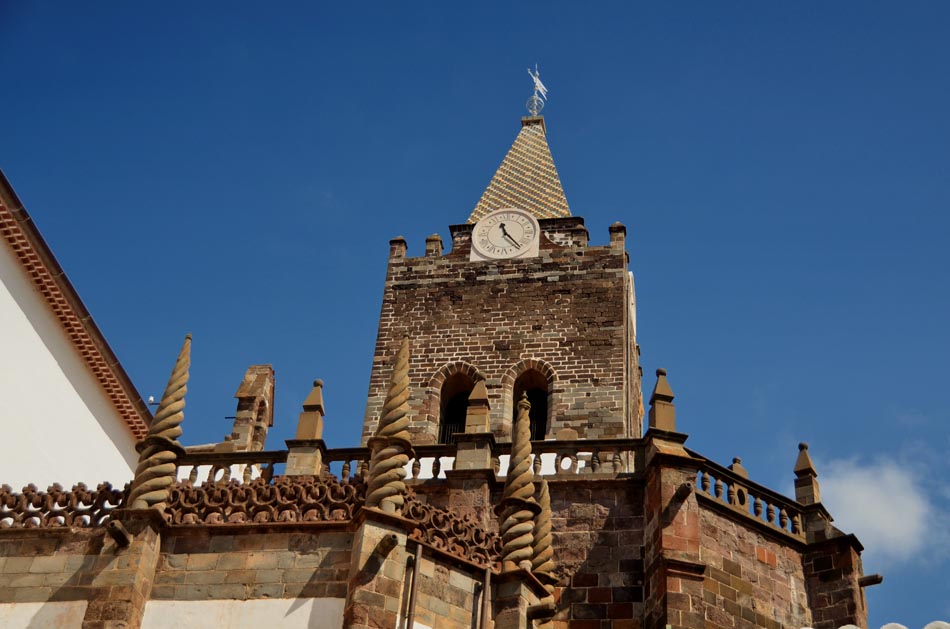

Sé de Funchal, Madeira


The clock in Madeira Island Cathedral, also a gift from Dr Michael Grabham


Dr Michael Grabham was also a writer and a businessman. He built the first Hotel in my hometown, today, unfortunately, in ruins. Some of his books are related to Madeira Island and the belief that the Island had therapeutic properties, mostly connected with lungs and respiratory diseases. He also wrote about nature (GRABHAM 1911) and other subjects.


Above, the first Hotel in my hometown's announcement in Dr Michael Grabham´s property. I found this in an old journal when I was doing research for my degree at Madeira University. This was found in the central library and archives of the Island.


A rare Dr Grabahm's photography that I found in an old journal. This is the announcement of his death.


Ayres de Ornelas e Vasconcelos family


Ayres de Ornelas e Vasconcelos family had an important presence in Camacha in the past. This family comes from the beginning of settlement after the discovery of Madeira in the year 1419. (Carita 1991) This family was noble and several lands were provided for them to control in the Island, including some land in my hometown. More recently, at the end of the 18th century they started to have a property in Camacha with a big summer house and wonderful gardens and footpaths. Quinta das Almas is the name of the property, today with a project for Turistic accommodation in process. 


Above, Quinta das Almas in Camacha, today.


The list of important and Historical figures of this family is long. Here I would like to introduce just two that were relevant personalities in the 18th and 19th century, in Portugal and overseas. Agostinho de Ornelas e Vasconcelos was a state and kingdom important figure in countries like Russia, Germany and others. He was a kind of international relations and diplomacy representative of Portugal in the countries he lived. He also was the first person to translate Fausto a famous Goethe's book to the Portuguese Language. (Maximiliano L. 1932) He was honoured by the superior school of Frankfurt for the translation of Fausto. An important figure at international level he used to come to my hometown to spend the summer and rest.

His son, Ayres de Ornelas e Vasconcelos was the last of the bloodline, and it was the last person of the family living in Quinta das Almas. He was a Militar, King Counsellor, Minister of the Sea and Colonies in one Portuguese Government.


Ayres de Ornelas e Vasconcelos and family in front of the summer house in Camacha. Quinta das almas. This photo was sent to me by a friend from my hometown.

Ayres de Ornelas e Vasconcelos was an important figure in Africa too where he was serving Portuguese Kingdom at the end of the 19th century. He was a writer and it is possible to find some articles and books that he wrote in his days of life in the different library and archive centres in Madeira and Portugal. He offered himself to fight in the first World War, but he did not go.

Another interesting heritage spot about this family is the world's first King Christ big statue, offered by Ayres de Ornelas e Vasconcelos, the last of the bloodline, to the Island of Madeira in the year of 1927, (DN 1/11/1927) before the King Christ famous statue in Brasil.


      Above and below, the King Christ statue in Madeira, offered by Ayres de Ornelas e Vasconcelos in the year of 1927.


GC4ZMP9 Cristo Rei (Traditional Cache) in Arquipélago da Madeira ...


Ayres de Ornelas statue in my hometown


Having in mind questions about heritage, preservation, local cultures and Globalization, I believe it is important to reveal this context of historical spots in my hometown and important figures of the past, in order to make an effort to rescue memories that can bring value to the place. In one hand we can argue that preservation is important for the future, even more, when places like Madeira has a long tradition of Tourism with the base of it connected not with transforming the destination in some curated place but, instead, providing the visitor with particularities from the nature and culture of the place itself.  "Heritage protection it seems, more than ever, to be seen as a strategy for the future"(Labadi and Long 2010). On the other hand, de-listing spots of heritage and History can happen naturally, or with the action of man. Forgetting history and heritage is something that can happen. But in the case of my hometown, as Harrison defends about the accumulation of heritage in the world, is not something that is happening. Camacha village is a small place with few attractions related to relevant history and having these two perspectives in mind, it is clear that something must be done to bring the forgotten memories back to our days.  "The process of forgetting is integral to the process of remembering" (Harrison, Rodney 2013). The football example is, in some way, one example of international cultural exchange, one of the first steps in my hometown related to the process of globalising something. Today, my village is trying to improve its image as an effort to attract more visitors and have a more local competitive economy, after some decades of crisis and changes. Using this heritage spots and histories is not something unique and is something that several destinations have been doing around the globe, but, for my hometown, it is, indeed, a way to use the cultural and heritage spots as an instrument for its memory, its identity and its relation with possible visitors.


REFERENCES

Carita, R. 1991. História da Madeira. Funchal: Secretaria Regional da Educação, Juventude e Emprego, Região Autónoma da Madeira.


  Diário de Notícias, Madeira Island, 01th November 1927, Public library of Madeira and Archives.

GRABHAM, M. 2020. Biological Stues in Madeira. Available at: https://www.nature.com/articles/110045a0?error=cookies_not_supported&code=a23186c6-730b-427b-aa32-8ab33b6725ee [Accessed: 10 April 2020].


GRABHAM, M. 1911. Biological Stues in Madeira. Available at: https://www.nature.com/articles/110045a0?error=cookies_not_supported&code=a23186c6-730b-427b-aa32-8ab33b6725ee [Accessed: 10 April 2020].


Harrison, Rodney, 2013, Heritage Critical Approaches, U.S.A and Canada, Routledge 

Labadi, S. and Long, C. 2010. Heritage and globalisation. Milton Park, Abingdon, Oxon, England: Routledge.

Lemos, Maximiliano, 1932, Enciclopedia Portuguesa Ilustrada, Volume XI.

Pereira, E. 1989. Ilhas de Zargo. Funchal [Madeira]: Edicão da Câmara Municipal.


SILVA, F. and AZEVEDO DE MENEZES, C. 1921. Elucidario Madeirense. vol. 1-2. A-Z. Funchal.


Notes: All the photos and images are mine or provided for friends and colleagues.


quinta-feira, 26 de março de 2020

"REMAPING" ANCIENT PATHS

Recently, the UK government made a proposal to all the hiking lovers in the country to report ancient paths they, for some reason, knew. This was an effort from the government to preserve and map ancient footpaths that are endangered and have a risk to disappear forever. The alert was given in the UK as demand for the preservation and memory of important historical and heritage sites. (Barkham 2020)

For the last 7 years, I have been participating in a volunteer exploration work, related to some similar intention, not in the UK, but in my country, more precisely, in my Island. Madeira Island has an important forest which is a UNESCO Heritage spot, concerning with the natural gender. (Centre 2020) and in the past, this forest was an important solution for the needs of the population and the use of natural resources. Lots of paths were built. The needs of wood, having space for cattle and so on were activities that turned the mountain region of Madeira an important site for survival and, consequently, a place where several paths and trails existed. The complex orography of the Island was also something very challenging for Madeirans and the need to connect the different villages of the Island originated a unique path chain. 

MADEIRA LÉS A LÉS is a volunteer group of nature lovers and explorers, and our goal is mostly to try to reopen and try to find several paths that were forgotten and had gone in face of the evolution and the change in the ways of life of the people in the Island. A good way to see what we do is to take a look at a short video below and some images.

https://www.facebook.com/madeiralesales/videos/584073428676123/?t=42

A imagem pode conter: céu, montanha, árvore, planta, ar livre, natureza e água


A imagem pode conter: uma ou mais pessoas, planta, árvore, ar livre e natureza


A imagem pode conter: montanha, céu, árvore, nuvem, planta, ar livre e natureza


It is important to make a distinction between these paths that we explore and other hiking possibilities in the Island. If in one hand Madeira has the Levadas and Officially recommended trails, on the other hand, these paths that I am talking, in the case of the archipelago, are a different dimension where sometimes can exist danger, and we can say are more inhospitable. Nevertheless, there is a lack of reflection about them, a lack of mapping, recording, preserving, and so on. If Levadas and Official trail are among studies and even films, "Cartas de Fora" is a recent film about the building of Levadas, these, now considered "alternative paths", are excluded from the reflections of local scholars and the cultural policy. Most of the work of reopen and exploration is made by groups of volunteers and nature lovers which, like MADEIRA LÉS A LÉS, use to go and try to find ways to pass through them. Talking with locals, research in old maps, have the orientation in a forest where is very easy to get lost is not for everyone, but it is amazing to see the echoes of a distant time. Stone walls, ancient ways to pave the trails, hidden old houses almost resembling fantasy scenarios are some of the heritage that we can find and are forgotten. In this way, the initiative of the UK Government is an example for those places who want to preserve and give more visibility to these heritage spots. Madeira Island is among them.


A imagem pode conter: 2 pessoas, pessoas em pé, céu, árvore, montanha, ar livre e natureza

The end of one successful exploration, after the locals, in the mountain base told us that it would be impossible to reach the top. No one was there for 40 years. Madeira, 2016. 


A imagem pode conter: planta, árvore, ar livre e natureza
An example of the ancient paths that we can find in the mountains of Madeira.


A imagem pode conter: céu, nuvem, oceano, ar livre e natureza

Some of the paths are connected by other small roads and trails where is not so dangerous to walk.


Even if we cannot talk about this kind o volunteer work as an academic work or official work, it is a fieldwork of exploration where it is important to walk and to reflect with critical thinking and eyes. More, this is a work directed to a lack of reflection and policy or strategy concerned with this kind of heritage, at least in Madeira Island. Having this in mind, it is obvious the importance of this fieldwork, something that we can support with the example of the Governors of the UK. This fieldwork is relevant in terms of cultural subjects like history, identity, landscape preservation, etc, but it is also fieldwork that needs to pay attention to other dimensions, including cartography, biology, climate change, water resources and so on. The multidisciplinary approach in this volunteer work is always present, something that is not easy to have one clear reference or a solid direction once is a work that is touching where no one touched before. Having that in mind, our group have been doing some efforts to register and record where we pass. Every hiking day is related in a piece of writing that we, sometimes, share with the followers of our Facebook page. We have already more than 20000 followers all around the world. Recording the paths that we reopen it is hard work, but we do that with photos and GPS apps where the trail can be accessed later. But this is inglorious. We need to keep visiting those places regularly. The persistent growing of plants and trees can delete the signs of the paths and it is very difficult to clean and open them again. This is something serious and really important for Madeira Island heritage and identity. For that reason, we started a project of writing a book where text, image, photo, map details will be among the goals. On the other hand, it is important to advert and alert for the danger of these kinds of paths and our objective is not open them to endanger our community and our visitors. If someone wants to visit them, he needs to make sure he is following safety recommendations and make sure he is in good physical condition. It is imperative to alert that the goal of this fieldwork is not to reopen paths to fill with people. No, it is not that, because most of them are in the middle of a unique forest. Our goal is to preserve them to some eventual need. Of course, this is polemic and complex. It can be argued that why just some people can go and visit those paths? We understand that question. This is not a question of elite, or privilege. Most of the people who wants to go with us, they just go once. During 10 years of the project, it is proved that this is not for everyone, because not everyone wants. So, the importance of preserving some paths, forgetting others, because many of them are gone forever, it is, indeed an important job to be done and maybe, the state, the governors and official identities and even the local University should pay attention to these kinds of volunteer groups that are playing an important role in the solidification of local identity of a small destiny, in this particular case, Madeira Island.


A imagem pode conter: uma ou mais pessoas, ar livre e natureza

Another journey in one of the most difficult old paths in Madeira called "Empenas"

https://www.facebook.com/madeiralesales/videos/780763442449075/?t=0

Above another link of a video.

A imagem pode conter: árvore, ar livre e natureza

Another difficult path, this one called "Laje Negra"


It is relevant to notice that Laurel Forest has been referred by naturalists for some time, including Charles Darwin in his famous work On the Origin of the Species. It is believed that this forest descends from the Meditteranean territory when there was no sea there. "On a small island, the race for life have been less severe, and there will have been less modification and less extermination. Hence, perhaps, it comes that the flora of Madeira, according to Oswald Herr, resembles the extinct tertiary flora of Europe" (Darwin, 1859 p.102) Respecting this heritage and save it for the next generations is something that is due and these paths and remapping them is an important work to be done. These kinds of volunteer groups of explorers are an instrument for that. For me, it is a pleasure to have the chance to work with these people. 


References

Barkham, P. 2020. Walkers urged to help save historic footpaths before 2026 deadline. Available at: https://www.theguardian.com/lifeandstyle/2020/feb/11/walkers-urged-to-help-save-historic-footpaths-before-2026-deadline [Accessed: 26 March 2020].

Centre, U. 2020. Laurisilva of Madeira. Available at: http://whc.unesco.org/en/list/934 [Accessed: 26 March 2020].

Darwin, C. 2009. ON THE ORIGIN OF SPECIES. London, Penguin Classics

Quintal, R. 1999. Levadas e veredas da Madeira. Funchal: Francisco Ribeiro.

segunda-feira, 16 de março de 2020

STREET MUSIC PROJECT


CAMACHOFONES BAND


By the year 2013, I and some of my friends from my hometown started a project of street music. Madeira Island, our home, is a very famous and touristic destination and our idea was the creation of a project to go to the streets of Funchal, the capital of Madeira, play for the locals and tourists and get some money. Initially, the idea was strongly connected with the reality of unemployment, a big problem for young people in a small island like Madeira with a lack of market opportunities.


For that project, the creation of a unique instrument called Tubofone was essential. The Tubofone can be seen in the image below.


A imagem pode conter: pessoas sentadas, sapatos, automóvel e ar livre

TUBOFONE, MUCH BETTER THAN A FERRARI


In the beginning, it was not easy to perform in the streets, in a city where these kinds of projects were not common. Even our families were sceptical about the idea. Playing in the streets is connected with homeless, misery and other depreciative ideas. Nevertheless, we knew that what we were doing was something unique for the place. Jazz, Afrobeat, Valsa, and other styles were among our list of cover songs and original. The Tubofone with a pentatonic scale was mainly doing the bass. Saxophones, trumpets, Tuba, Trombone, percussions and vocals, altogether turned in a unique music project that started to have feedback from locals and visitors from every corner in the world.


A imagem pode conter: uma ou mais pessoas e pessoas sentadas


CAMACHOFONES PLAYING, A PAINTING OF A TOURIST AND FAN


After the first years, the project started to have really good feedback from the public. It was a bureaucratic battle against the local authorities to find a legal solution to play in the streets. There was an absence of a Cultural Policy for projects like CAMACHOFONES. After some meetings and discussions with local politicians and authorities, we had, in a regime of exception, a license to play in the streets. The project was a stimulating force to start a debate about street art in Madeira and the possible Cultural Policy related.


The project went so well that we travelled to Lisbon and Porto, the two most important cities in the mainland of Portugal. In Lisbon the struggle against the authorities and the local governments was surreal. It is incredibly confusing the cultural policy in the Portuguese Capital. We were constantly stopped by the police and the public were protesting against them. We had so many people watching us play that we took the risk and we kept performing, always trying to escape police and authorities with the feeling of doing some crime when we were just playing music with a big audience all the time. We were arrested and we had to pay a fine once.


Nenhuma descrição de foto disponível.

Above, the argument's moment with the authorities.


In Porto, the cultural mentality seems to be different and we were very welcome there with no problems in having the license to play. It was amazing. We were two times in Lisbon and one time in Porto. We had a chance to go to Barcelona, but Catalunya has also a very complex Cultural Policy and we cancelled the journey. All of our journey outside of Madeira was sponsored only with our work and our own money that we earned in the street performances and with the sellings of our first album, released in 2016. 


Nenhuma descrição de foto disponível.
CAMACHOFONES IN LISBON, 2015


A imagem pode conter: 1 pessoa, ar livre
                                                               CAMACHOFONES IN PORTO, 2016


Internationalization and Pseudo-internationalization


After some years of work and after our project started to have an impact locally and overseas, we started to notice something that we call "Internationalization without moving". Of course, we are talking about the phenomenon of moving in real life, travelling, playing in a different destination. With the Touristic reality in the Island, where people from different places and cultures use to be present during the year, and after selling a considerable number of CDs, we realized that our work was starting to have feedback from several different places in the world. Messages from different countries were coming to us in our email and our Facebook page. Having in mind ideas and concepts of digitalization, Globalization, cultural content dissemination, we can ask if are we in a context of real internationalization of our work or not? There are two sides to this question. First, our digital content, videos, photos, etc are among the new dynamics of Global dissemination, the McLuhan's concept of "Global Village". Here we are talking about something different compared to what we realized secondly. The feedback in an International level was mostly related to the CDs we use to sell to the visitors on the Island. This is something different because there is an element of real contact, of real life in the argument. To have feedback about our original songs and our Cd, it needs to exist real contact because our Cd is not Online or uploaded in some musical platform on the Internet. We realized that our work was having an International level without moving (from the side of the content, from the side of our part) because our public, most of the times, is from different countries, different cultures. Indeed, they are the side of the relationship that needs to move. But what we reflected was "Internationalization without moving" from the cultural product. Another important fact that was important for us in the development of this reflection was the existence of musical projects in the Island and in the country that are normally said to be International projects because they have been travelling around the world. The problem is, in our reflection, that those projects are travelling all the time to play for the diaspora, the Portuguese people living around the world. Our question is strongly related with the public, and those projects, even travelling outside of Portugal, they are not changing the public, they are not having feedback from different cultures and people from different countries. The public is always the "same". Can we talk about Internationalization and Pseudo-Internationalization from the public point of view? We believe it is a good reflection to do having concepts of globalization, culture, dissemination, art and so on in mind.


Nenhuma descrição de foto disponível.


Today the project is still going on. CAMACHOFONES are a project with several gigs in agenda and with the idea to release the second album of original songs. Something that began with a big struggle against the conventions and mentalities is now a reference of originality and, of course, music. My presence in the band has been intermittent in reason of my studies, my literature and writer life, professional life and my other band. Nevertheless, it is a project that I am proud to belong and the future is here for us.

It is easy to find our work on Youtube, just clicking the name CAMACHOFONES


We also have a Facebook page www.facebook.com/camachofones


João Paulo Nóbrega Freitas

Cardiff, 16th March 2020

quinta-feira, 5 de março de 2020

VISITING BATH WITH ETHNOGRAPHIC EYES


Recently I was in Bath city for a few days. I always heard about this place as one of the most interesting places in the United Kingdom. Of course, this is always subjective, and it depends on several perspectives. I am currently studying in the lovely city of Cardiff, doing an MA in Global Cultures and my visit to Bath had different purposes, one of them was the idea to see in person if the city could be one example of preservation, an example of a mixture between history, the past and the present. This idea is related to my dissertation subject for my Master where I want to reflect on heritage, preservation, identity, local cultures, cultural landscapes and the phenomenon of tourism and globalization.

I believe it is important to have one brief historical approach about Bath. The city is known as ancient Roman City and the name Bath indicates what we can find in the city as one relevant memory of the presence of the Roman Empire. The famous SPA and thermal waters are something present and related to Romans. However, the valley is known as a Celtic territory times before the Roman presence. With this, we can understand that the city is Historically relevant and there is that consciousness when we research, for instance, on the Internet about the city.


A SPA pool in Bath


On the other hand, I was in Bath, of course, as a traveller, trying to feel the environment, to enjoy the streets and get sensations. Below there is a photo that I took with my phone. The palm trees, in my opinion, give us one subtle and exotic touch to the panorama, where, in February, we can say it is a cold valley.


Bath Valley February 2020


 During the time I was there, I realized the struggle of the authorities to have a policy of preservation in the city. The building’s colour is normally the same, even when a new building is in the process of construction. There is, for sure, exceptions, and the modernization and the development pressure is not easy to escape, but, even so, the city seems to be one good example of preserving the identity,   the history, the past, giving a new dynamic to architectonic heritage, normally turning it in touristic spots, a relevant industry in town.


Avon River, Bath, February 2020


Walking through the city is nice there. There is several nice restaurants, cafes, pubs, theatres, we can see street musicians waiting for good weather to give some music to the city. The old Market and the University are also relevant infrastructures in the city. 


.


There is no doubt about the beauty of the city, as we can see in the photos. Some famous people are connected to the city. I will give just one example. Jane Austen, a famous writer. There is a small museum about her in town. This writer also inspired other artworks, including the cinematic industry. Pride and Prejudice, a film with the actress Keira Knightley is based on the novel with the same name.

Different attractions can be seen around Bath, like the Abbey where Kings were crowned and also art galleries and nice book shops. I found a gallery with Bob Dylan´s paintings, maybe an artistic dimension less known about the American musician. Some of them very expensive as shown below.


After getting back to Cardiff I found some books about the cultural policy for the city, mostly related with the architectonic design of the city. Nevertheless, this was mostly a visit, where a Non-representational method and an ethnographic approach were my main objectives. The feelings that I got were very good. The only issue is always the weather which for a person from an tropical Island is not easy, mostly when in the UK the tendency to have rain and dark clouds is more often. 

João Paulo Nóbrega Freitas

Cardiff 2020


References


Bath: a study in conservation 1968. London: H.M.S.O.

Cherishing outdoor places 1994. Bath [England]: Director of Environmental Services, Bath City Council.

Harrison, R. 2017. Heritage. Johanneshov: MTM.


Worskett, R. 1978. Saving Bath: a programme for conservation. Bath.


Classic Columns in Bath February 2020